Most account compromises do not happen because attackers are sophisticated - they happen because defenses are incomplete. A password alone, no matter how complex, is a single point of failure. One phishing email, one leaked database, one moment of inattention, and that single layer collapses. What stands between an attacker and full account access is rarely a lack of intent on their part; it is the presence of layered, well-implemented security on yours.
Account security is not a single feature you switch on. It is a system built from interdependent components: how identity is verified, how the login process is protected, how users regain access when credentials are lost, and whether a second line of defense exists when the first one fails. Each layer has its own vulnerabilities and its own best practices. Understanding how they connect - and where gaps tend to appear - is what separates a genuinely secure account from one that only feels secure. When users interact with platforms like accmarket login, knowing which protections are in place and which ones depend on your own choices is not optional knowledge; it is fundamental to staying protected.
This article covers each layer of account security in practical terms: what user authentication actually involves, what makes a login flow genuinely secure, how to design and use password recovery without creating backdoors, and why multi-factor authentication changes the threat landscape so dramatically. Whether you manage systems or simply use them, the principles here apply directly to your situation.
Understanding the Foundations of Account Security
Account security is the set of mechanisms and policies that ensure only authorized individuals can gain account access. That definition sounds straightforward, but the implementation is anything but. Security must balance protection with usability - a system so locked down that legitimate users cannot get in has failed just as completely as one that lets attackers through.
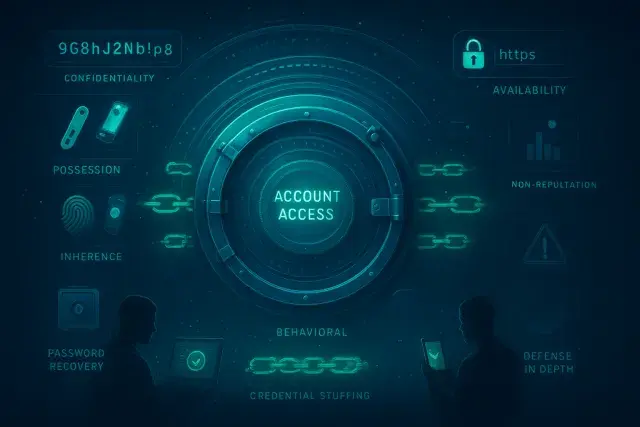
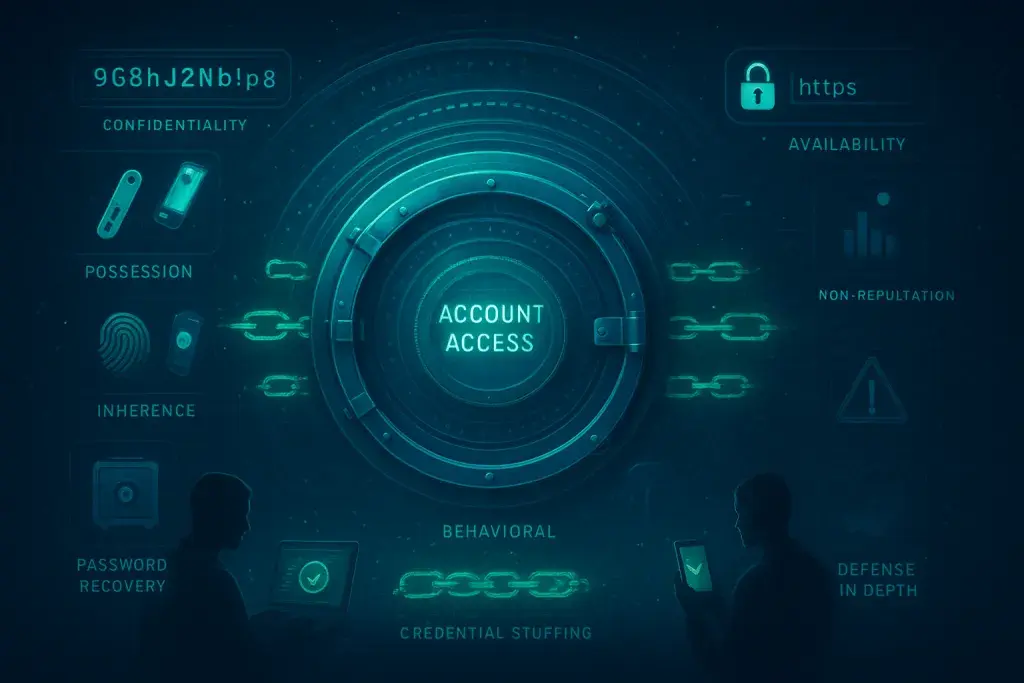
The theoretical backbone of account security rests on three independent verification factors. The first is something you know, such as a password or PIN. The second is something you have, such as a hardware token or a mobile device. The third is something you are, expressed through biometrics like fingerprints or facial recognition. Strong security systems combine at least two of these factors, so that compromising one does not automatically mean compromising access.
A widespread and costly misconception is that account security is entirely the platform's problem. In practice, responsibility is shared. Platforms must implement robust user authentication, protect the login process, and provide reliable recovery options. Users must practice sound credential hygiene, enable available protections, and remain alert to social engineering. When either side neglects its responsibility, the entire system weakens.
Four properties define a well-secured account system:
- Confidentiality - account data and credentials are accessible only to authorized individuals
- Integrity - account information cannot be modified without proper authorization
- Availability - legitimate users can always regain account access through secure, functioning recovery paths
- Non-repudiation - the system can trace and verify which authenticated identity performed a given action
These four properties are not independent goals - they are interdependent. A system that prioritizes availability at the expense of integrity, for example, will eventually create exploitable recovery paths. Every design decision in account security involves trade-offs between these properties, and understanding those trade-offs is what makes the difference between a system that holds and one that fails quietly.
User Authentication: How Identity Verification Works
User authentication is the process by which a system confirms that the person attempting to gain access is who they claim to be. It is the first gate, and everything else - session management, authorization, activity logging - depends on it working correctly. A broken authentication layer cannot be compensated for by stronger defenses elsewhere.
Types of Authentication Methods
Authentication methods differ substantially in how they verify identity, how resistant they are to attack, and how much friction they introduce for users. No single method is ideal in all contexts, which is why understanding the full landscape matters for both implementation decisions and personal account management.
| Authentication Type | Example | Security Level | User Convenience | Best Use Case |
|---|---|---|---|---|
| Knowledge-based | Password, PIN, security questions | Low to Medium | High | Basic access control |
| Possession-based | Hardware token, SMS code, authenticator app | Medium to High | Medium | Two-step verification |
| Inherence-based | Fingerprint, face recognition, voice | High | Very High | Device-level security |
| Behavioral | Typing pattern, mouse movement analysis | Medium | Transparent to user | Continuous background authentication |
| Certificate-based | Digital certificates, public key infrastructure | Very High | Low | Enterprise and developer access |
Knowledge-based methods are the most commonly used but also the most easily compromised. Passwords can be guessed, phished, or leaked. Security questions are particularly weak - the answers are often discoverable through public profiles or social media. Possession-based methods raise the bar significantly because an attacker needs physical access to a device, not just data. Inherence-based methods are strong and convenient but require appropriate hardware and carry privacy considerations. Certificate-based authentication offers very high assurance but is complex to manage, making it most practical in controlled enterprise environments.
How Authentication Tokens and Sessions Work
After a user successfully completes the authentication process, the system needs a way to maintain that verified state throughout the session without asking the user to re-authenticate on every page load. This is accomplished through session tokens - temporary, encrypted identifiers that represent the authenticated session.
The security of these tokens is critical. A stolen session token allows an attacker to impersonate an authenticated user without ever knowing their password. This attack vector, known as session hijacking, is why token management deserves as much attention as the login process itself.
- Tokens must be randomly generated with sufficient entropy to make guessing computationally infeasible
- Tokens must have a defined expiration time and should expire after a reasonable period of inactivity
- Logging out must immediately invalidate the token server-side, not just remove it from the client
- Tokens must be transmitted exclusively over encrypted connections and stored in HttpOnly cookies to block client-side script access
- In OAuth-based systems, short-lived access tokens should be kept separate from longer-lived refresh tokens
Token rotation - issuing a new token at regular intervals or after privilege-sensitive actions - further limits the window of exposure if a token is intercepted.
Common Authentication Vulnerabilities to Avoid
Even systems built with good intentions regularly suffer from predictable, well-documented weaknesses. Awareness of these vulnerabilities is the first step toward closing them.
- Credential stuffing - attackers take username and password combinations leaked from one service and automatically test them across others, exploiting password reuse
- Brute-force attacks - automated tools cycle through possible passwords at high speed, particularly effective against short or common passwords
- Session hijacking - stolen or intercepted session tokens used to impersonate an already-authenticated user
- Insecure "remember me" features - long-lived tokens stored without proper protection give attackers persistent access if the device or storage is compromised
- Weak token generation - predictable or short tokens that can be guessed or inferred through pattern analysis
Each of these has established countermeasures: rate limiting, account lockout policies, anomaly detection, secure token storage, and enforced re-authentication for sensitive operations. The secure login practices covered in the next section address many of these directly.
Secure Login: Best Practices for Protecting the Entry Point
The login endpoint is the most targeted surface in any account system. Attackers focus on it because it is the publicly accessible gateway to everything else. A secure login process means hardening not just the form itself, but every step of the credential submission and verification flow - including how the system responds to both success and failure.
Designing a Secure Login Flow
Security at the login level is cumulative. Each individual measure reduces a specific attack vector; together, they create a login flow that is genuinely resistant rather than superficially protected.
- Enforce HTTPS site-wide with valid, current TLS certificates - credentials must never travel over an unencrypted connection under any circumstance
- Submit credentials via POST requests - passwords must never appear in URLs, where they would be visible in server logs and browser history
- Implement rate limiting on login attempts, and lock accounts temporarily after a defined number of consecutive failures
- Return generic error messages on failed login - specifying whether the username or password was incorrect separately helps attackers enumerate valid accounts
- Log all login attempts with timestamps and originating IP addresses to support anomaly detection and forensic investigation
- Validate and sanitize all inputs server-side to prevent injection-based attacks regardless of client-side validation
- Include CSRF tokens on login forms to block cross-site request forgery attempts that could trick browsers into submitting credentials to a malicious endpoint
These steps are not optional enhancements for high-security applications - they are baseline requirements for any login system that handles real user data.
Password Hashing and Credential Storage
A properly built secure login system never stores passwords in readable form. What it stores is a cryptographic hash - a fixed-length output derived from the password through a one-way function. If the database is breached, properly hashed passwords cannot be reversed into the originals without enormous computational effort, assuming the right algorithm was used.
| Hashing Algorithm | Recommended? | Reason |
|---|---|---|
| Argon2 | Yes - preferred | Memory-hard by design, winner of the Password Hashing Competition, highly resistant to GPU-based cracking |
| bcrypt | Yes | Adaptive cost factor allows tuning over time, slow by design, widely supported across platforms |
| scrypt | Yes | Memory-intensive, resistant to hardware-accelerated attacks |
| SHA-256 without salt | No | Fast execution makes brute-force practical; vulnerable to precomputed rainbow table attacks |
| MD5 | Never | Cryptographically broken; collisions are trivially achievable with modern hardware |
Beyond choosing the right algorithm, each password must be hashed with a unique, randomly generated salt - a value added to the password before hashing. Salting ensures that two users with identical passwords produce entirely different hash values, neutralizing precomputed attack tables and making bulk cracking dramatically more expensive for an attacker.
Detecting and Responding to Suspicious Login Activity
Prevention is the goal, but detection is the safety net. Even with strong defenses in place, no system will stop every attempt. The ability to detect anomalies quickly and respond appropriately - without blocking legitimate users - is what separates reactive security from resilient security.
- Flag and review logins originating from unfamiliar geographic regions or IP addresses that have no prior history with the account
- Send immediate notifications to the account owner when a successful login occurs from a new device or location
- Temporarily restrict accounts after repeated failed attempts and require verified identity confirmation before restoring access
- Deploy bot detection mechanisms, including challenge-response tests, to block automated credential attacks before they reach the authentication logic
- Implement risk-based authentication, which triggers additional verification steps only when behavioral or contextual signals suggest elevated risk
The goal of anomaly response is not to be maximally disruptive - it is to be precisely disruptive. Blocking a legitimate user indefinitely because they logged in from a new city is a failure mode, not a success. Calibrated responses that match the level of risk to the level of friction are the hallmark of a mature secure login implementation.
Password Recovery: Building a Process That Protects, Not Exposes
Password recovery is one of the most consistently mishandled components of account security. The recovery process, by its nature, must provide a path for users who cannot authenticate normally - which means it must operate partly outside the standard authentication flow. That creates risk. A recovery mechanism designed carelessly becomes a privileged backdoor that attackers actively probe.
Secure Recovery Channel Design
The channel through which a user receives a recovery link or verification code must be treated with the same rigor as the login process itself. If the recovery channel is weak, the strength of the login system becomes irrelevant - an attacker simply bypasses login through recovery.
- Send recovery links to a verified email address, and display only a partially masked version of the address on the recovery confirmation screen to prevent account enumeration
- SMS recovery codes are acceptable for many accounts but carry SIM-swapping risk - an attacker who convinces a mobile carrier to transfer a phone number gains access to SMS-delivered codes
- Recovery links must be time-limited, with expiration windows typically between 15 and 60 minutes, and must be invalidated after a single use
- Recovery emails should include contextual information - such as the requesting device type, approximate location, and timestamp - so users can recognize fraudulent requests they did not initiate
- All active sessions must be invalidated immediately when a password reset is completed successfully
Avoiding Common Password Recovery Mistakes
Most password recovery failures follow a predictable pattern. The same implementation mistakes appear repeatedly across different platforms and account types, and they are all avoidable with deliberate design.
| Mistake | Risk Created | Correct Approach |
|---|---|---|
| Emailing the actual password to the user | Proves the system stores passwords in readable form - a critical security failure | Always send a time-limited reset link; never send the password itself |
| Relying on security questions | Answers are frequently guessable from public information or social profiles | Eliminate security questions entirely; use verified communication channels instead |
| Recovery tokens that do not expire | An intercepted link remains usable indefinitely, creating a persistent attack window | Enforce short expiration periods and invalidate tokens immediately after use |
| Not logging recovery attempts | Attackers can probe the recovery system repeatedly without triggering any alert | Log all recovery requests with timestamps and IP addresses; monitor for unusual frequency |
| Reusing the same token across multiple reset attempts | Replay attacks become possible if the token is intercepted in transit | Generate a new, cryptographically random token for every recovery request |
Backup Verification Methods
Relying on a single recovery channel creates a single point of failure. If a user loses access to their primary recovery email, or if that channel itself is compromised, they need a fallback that is itself genuinely secure. Backup methods must be set up proactively - before the emergency that requires them.
- A separately verified backup email address - ideally one not used for any other account registration
- Offline backup codes generated during authenticator app setup, stored securely and never shared
- Identity verification through official documentation for high-value accounts where the stakes justify the additional friction
- Hardware security keys registered as backup devices, providing a physical fallback that does not depend on any communication channel
The key principle here is separation. A backup method that depends on the same compromised channel as the primary method offers no real protection. Effective backup verification adds an independent layer, not just a redundant copy of the first.
Multi-Factor Authentication: The Most Effective Layer of Protection
Multi-factor authentication addresses a fundamental weakness in any single-factor system: the assumption that one piece of evidence is sufficient to prove identity. When authentication requires multiple independent factors, compromising one - whether through phishing, a database leak, or brute force - is no longer enough. An attacker who has your password but not your second factor is still locked out.
How Multi-Factor Authentication Works
The mechanics of multi-factor authentication are straightforward. After a user provides their primary credentials, the system does not immediately grant account access. Instead, it prompts for a second, independent proof of identity. Only after both factors are verified does the system complete the login.
- The user enters their username and password - the first factor, based on knowledge
- The system validates the credentials and, if correct, initiates the second factor challenge
- The user provides the second factor - a time-based code from an authenticator app, a push notification approval, or a hardware key response
- The system verifies the second factor independently from the first
- Only when both factors pass does the system grant full account access and establish a session
The independence of the two factors is what makes this model effective. If both factors relied on the same channel or the same device, a single compromise could defeat both. True multi-factor authentication ensures that each factor requires a separate and distinct form of access to defeat.
Comparing MFA Methods
Not all multi-factor authentication implementations offer equivalent protection. The differences between methods matter, particularly for accounts where the consequences of compromise are severe.
| MFA Method | Security Level | Phishing Resistant | Setup Complexity | Best For |
|---|---|---|---|---|
| SMS one-time code | Medium | No | Very Low | General consumer accounts where some protection is better than none |
| Email one-time code | Medium | No | Very Low | Low-risk secondary verification step |
| Authenticator app (TOTP) | High | Partially | Low | Most personal and professional accounts |
| Push notification approval | High | Partially | Low | Mobile-first users with app-based workflows |
| Hardware security key (FIDO2) | Very High | Yes | Medium | High-value accounts, enterprise environments |
| Passkeys (device-bound) | Very High | Yes | Low on modern devices | Consumer and enterprise use on compatible hardware |
SMS-based codes are better than nothing, but they are the weakest form of multi-factor authentication due to SIM-swapping vulnerabilities. Authenticator apps generate time-based codes locally on the device, removing the phone network from the equation entirely. Hardware security keys and passkeys are the strongest available options because they are cryptographically bound to the legitimate site - a phishing site cannot extract a valid response from them, even if a user is tricked into visiting it.
Implementing MFA Without Frustrating Users
The most common argument against multi-factor authentication is that it creates friction. That argument holds less weight than it once did, both because the friction is modest compared to the protection gained, and because thoughtful implementation can reduce that friction considerably.
- Use adaptive, risk-based MFA triggers - require the second factor only when risk signals are present, such as a new device, an unrecognized IP address, or an unusual login time
- Allow users to designate trusted devices for a defined period, so they do not face a second factor prompt on every routine login from a familiar environment
- Offer multiple MFA options - some users prefer authenticator apps, others prefer push notifications; giving a choice increases adoption
- Provide clear, step-by-step setup instructions to reduce the abandonment rate during initial enrollment
- Build an explicit recovery flow for when the MFA device is unavailable, so users know in advance how to regain access without compromising the protection MFA provides
The friction argument often masks a simpler reality: unfamiliar processes feel burdensome, while familiar ones do not. Users who set up MFA and use it regularly typically report that it becomes a non-issue within a short period. The one-time investment in setup pays ongoing dividends in protection.
Combining All Layers: Building a Comprehensive Account Security Strategy
Individual security measures have value. But the reason layered security is so much more effective than any single control is that it forces an attacker to defeat multiple independent obstacles simultaneously - and failing at any one of them is enough to stop the attack. The following sections translate this principle into concrete action for both developers and users.
Security Checklist for Developers and Platform Owners
Building secure account systems is an engineering discipline with clear requirements. The following checklist covers the critical implementation points across all security layers discussed in this article.
- Deploy HTTPS site-wide with valid, current TLS certificates and enforce HSTS (HTTP Strict Transport Security) to prevent downgrade attacks
- Store all passwords using Argon2 or bcrypt with unique per-user salts - never store passwords in plain text or with reversible encryption
- Apply rate limiting and temporary lockout on all authentication-related endpoints, including login, password recovery, and MFA verification
- Issue single-use, time-limited tokens for all password recovery flows and generate a new token for every request
- Offer multi-factor authentication to all users and, for sensitive account types, make it mandatory
- Log all authentication events - successful logins, failed attempts, password changes, MFA enrollment - and monitor logs for anomalous patterns
- Send automated notifications to users for significant account events: new device login, password change, MFA method added or removed
- Conduct periodic security reviews of all authentication and recovery flows, including testing for common injection and enumeration vulnerabilities
- Apply the principle of least privilege - authenticated users should access only the resources and actions their role requires
- Maintain a documented incident response plan specifically for credential compromise scenarios, including mass reset procedures if needed
Security Checklist for End Users
Platform security determines the ceiling of protection available to users. Personal security practices determine how close to that ceiling each individual account actually sits.
- Use a unique password for every account - credential stuffing attacks succeed entirely because of password reuse across services
- Enable multi-factor authentication on every account that offers it, prioritizing email, financial, and workplace accounts
- Use a reputable password manager to generate and store complex, unique credentials without relying on memory
- Periodically check whether your email address has appeared in known credential leaks using a reliable public breach notification service
- Treat unsolicited password recovery emails with suspicion - if you did not request a reset, someone else did
- Keep recovery contact information current - an outdated recovery email or phone number locks you out and leaves you dependent on slow manual verification processes
- Log out of accounts on devices you do not control, and review active sessions periodically in account settings to revoke any you do not recognize
- Store MFA backup codes in a physically secure location, separate from the device used for authentication
How Security Layers Reinforce Each Other
Abstract principles become clearest through concrete scenarios. Consider an attacker who successfully obtains a user's password through a phishing email. Here is how a properly layered system responds at each point:
- The login attempt from an unrecognized IP address triggers an anomaly flag, generating an alert email to the account owner
- Rate limiting prevents the attacker from making rapid repeated attempts if they try variations
- Multi-factor authentication demands a second factor - the authenticator app code - which the attacker does not have
- The account owner, notified of the suspicious login attempt, immediately changes their password through the secure recovery process
- The password change invalidates all active sessions, including any partial sessions the attacker may have initiated
- Because the recovery email is separately secured with its own MFA, the attacker cannot intercept the reset link
No single control stopped this attack. Each layer caught or limited something the previous layer did not fully address. This is what defense in depth means in practical terms: not redundancy for its own sake, but independent barriers that do not share the same failure modes.
Questions and Answers
If I use a strong, unique password for every account, do I still need multi-factor authentication?
Yes. A strong, unique password significantly reduces the risk from brute-force and credential stuffing attacks, but passwords can still be phished, intercepted in transit on a misconfigured server, or exposed in a breach on the platform's side - none of which depends on your password being weak. Multi-factor authentication protects the account even when the password itself has been compromised, which is a threat no password strength alone can address.
What is the safest way to store the backup codes generated during MFA setup?
Print them or write them down and store them in a physically secure location - a locked drawer, a safe, or somewhere similarly protected from unauthorized access. Storing them in an email drafts folder, a notes app, or a cloud document tied to the same account they are meant to protect defeats the purpose entirely. The backup codes must be accessible when your primary MFA device is not, which means they need to exist independently of any digital service that could itself be locked or compromised.
How does risk-based authentication decide when to require a second factor?
Risk-based authentication evaluates contextual signals at the time of each login attempt. These typically include the device fingerprint, the IP address and its associated geographic region, the time of day relative to past login patterns, and whether the session matches previously observed behavior. When the combination of signals falls within a normal range for that account, the system may allow login with reduced friction. When signals deviate significantly - a new country, an unrecognized device, an unusual hour - the system escalates to a stronger verification step before granting account access.
Can an attacker bypass multi-factor authentication entirely?
Some MFA methods are more bypassable than others. Real-time phishing attacks can trick users into submitting their TOTP codes to a fake site, which the attacker immediately relays to the real site. Push notification fatigue attacks involve sending repeated approval prompts until a user accidentally or frustratedly approves one. SMS-based codes are vulnerable to SIM-swapping. Hardware security keys and passkeys based on the FIDO2 standard are specifically engineered to defeat these techniques because the cryptographic response is tied to the legitimate origin domain - a fake site simply cannot obtain a valid response, regardless of what the user does.
What should I do immediately if I suspect my account has been accessed without my authorization?
Change your password immediately using a device and network you trust, then review and revoke all active sessions from your account settings. Check whether your recovery email and phone number have been altered - attackers often modify these first to lock the legitimate owner out. Re-enroll or verify your MFA configuration. Finally, review recent account activity for any actions taken during the unauthorized access period, and report the incident to the platform's support team so they can investigate from their end and flag the account for additional monitoring.
Is it safe to use the password recovery option if I have forgotten my password but have not been breached?
Yes, using password recovery for a forgotten password is exactly what the feature is designed for. The security concern is not with legitimate users using it - it is with the design of the recovery process itself. As long as the platform sends a time-limited, single-use link to a verified channel that only you control, and as long as your recovery email or phone is itself secured, the process is safe. After resetting your password, set up a password manager so future resets become unnecessary.